Key Takeaways
- The CDL skills test has three required parts: the vehicle inspection, the basic control skills test, and the on-road driving test. A candidate must pass all three to earn a commercial driver’s license.
- A candidate who fails the pre-trip inspection part does not move on to the rest of the test.
- The basic control skills test checks how well a candidate handles the vehicle in tight spaces through maneuvers like straight-line backing, offset backing, and alley docking.
- The on-road test happens in live traffic and checks whether a candidate can start, stop, shift, turn, and follow the rules of the road safely.
- Examiners score candidates on encroachments, pull-ups, and outside observations. Too many errors in any one part can end the test early.
- A test candidate should plan for two to three hours at the testing site, and the vehicle used must match the CDL class being tested for.
The Three Parts of the CDL Skills Test
The CDL skills test is the final step before a driver earns a commercial driver’s license. Every state administers the test in the same three parts, since the requirements come from the Federal Motor Carrier Safety Administration, known as FMCSA. A candidate must pass each part in order. Failing one part usually means the test stops there, and the candidate has to schedule a retest for that section.
This structure exists because trucking involves different kinds of skill. Reading a truck’s condition, maneuvering it in a tight yard, and driving it safely in traffic are three separate abilities. The test checks all three before handing over a license.
Part 1: The Vehicle Inspection
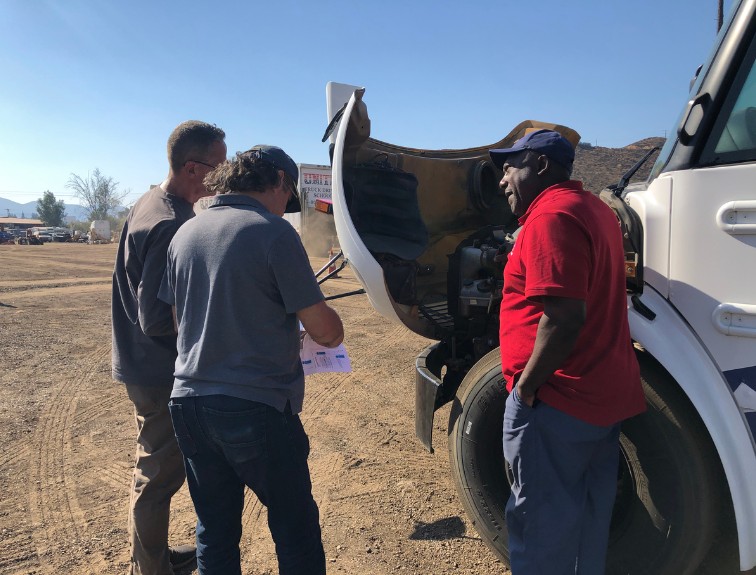
The first part of the CDL skills test is the vehicle inspection, also called the pre-trip inspection. The candidate walks around the vehicle and explains to the examiner what they are checking and why. This covers the engine compartment, the cab, the lights, the tires, the brakes, and, for Class A candidates, the coupling system.
Candidates must point to or touch each item while explaining it. Reciting memorized lines without looking at the parts is one of the most common reasons candidates lose points. If the vehicle has air brakes, the candidate also has to demonstrate the air brake check, including how the system builds pressure and how the low-pressure warning works.
A full breakdown of what this part covers, how long it should take, and the most common mistakes candidates make is available in What You Need to Know About Pre-Trip Inspections in 2026. A candidate has to pass the vehicle inspection before the examiner moves on to the basic control skills test.
Part 2: The Basic Control Skills Test
The second part checks how well a candidate can control the vehicle in a confined space, away from other traffic. Examiners choose from a set of standard maneuvers, which may include:
- Straight-line backing
- Offset backing to the right
- Offset backing to the left
- Parallel parking (driver’s side)
- Parallel parking (conventional)
- Alley docking
A candidate is not tested on every maneuver. Examiners select a subset, and the exact combination can vary by state and by testing site.
How the Basic Control Skills Test Is Scored
Examiners track four things during this part of the test:
- Encroachments. Every time the vehicle touches or crosses a boundary line or cone, it counts as an error.
- Pull-ups. Stopping and reversing direction to reposition the vehicle counts as a pull-up. The first pull-up in each exercise is usually free, but extra pull-ups add up.
- Looks. Getting out of the vehicle to check position counts as a “look.” Too many looks in one exercise can cost points.
- Final position. The vehicle has to end the exercise in the exact spot the examiner describes. Missing the final position can fail that exercise even if the rest of the maneuver was clean.
Refusing to attempt a maneuver, or failing to complete one as instructed, can result in an automatic failure of this part of the test.
Part 3: The On-Road Driving Test
The third and final part takes place in live traffic. The examiner rides along and evaluates the candidate’s judgment, vehicle control, and ability to follow traffic laws under real conditions. This includes starting and stopping smoothly, shifting through gears, turning at intersections, changing lanes, merging, and responding to traffic signals and signs.
The on-road test also checks habits that don’t show up in a controlled yard, like mirror checks, following distance, and how a candidate handles hills, curves, and railroad crossings. Examiners are watching for consistent, safe behavior over the whole route, not just a handful of test-day maneuvers.
What to Expect on Test Day
A CDL skills test typically takes two to three hours from start to finish, including time between sections. Candidates need to bring a valid commercial learner’s permit, a medical certificate, and any other documents their state requires. The vehicle used for the test has to match the class of CDL the candidate is pursuing, so a Class A candidate tests in a Class A vehicle.
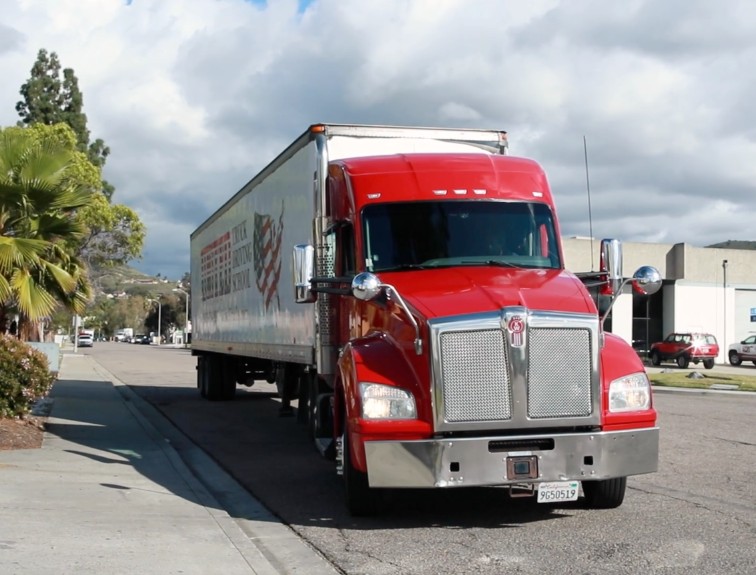
Most CDL schools, including United Truck Driving School, provide the test vehicle as part of training. This matters because a candidate who trains and tests in the same truck already knows its blind spots, mirror angles, and handling before test day.
What Happens If a Candidate Fails
Failing one part of the CDL skills test does not mean starting over from scratch. States generally allow a retest of just the failed section, though rules on timing and retest limits vary.
United Truck Driving School’s Class A CDL and Class B CDL programs prepare students for all three parts of the skills test through classroom instruction and hands-on practice in the yard and on the road. Contact a campus representative at the San Diego or Riverside campus, or visit the admissions page to learn more about enrollment and job placement support after graduation.
FAQs
How many parts does the CDL skills test have?
Three. A candidate must pass the vehicle inspection, the basic control skills test, and the on-road driving test, in that order.
Can a candidate skip the vehicle inspection and start with the driving portion?
No. The vehicle inspection comes first, and a candidate must pass it before moving on to the other two parts.
How long does the CDL skills test take?
Most candidates should plan for two to three hours at the testing site, including setup time between each part of the test.
What happens if a candidate crosses a boundary line during the basic control skills test?
That counts as an encroachment, which is scored as an error. Too many encroachments in one exercise can fail that part of the test.
Does the test vehicle have to match the CDL class a candidate is applying for?
Yes. A candidate testing for a Class A license must test in a Class A vehicle, and the same rule applies to Class B.
Are candidates tested on every backing maneuver during the basic control skills test?
No. Examiners choose a subset of maneuvers, such as straight-line backing, offset backing, or alley docking, rather than testing every possible exercise.
What does the on-road portion of the test evaluate?
It evaluates a candidate’s ability to drive safely in live traffic, including starting, stopping, shifting, turning, and following the rules of the road.
Does failing one part of the test mean starting over completely?
Usually not. Most states allow a candidate to retest only the section they failed, though rules vary by state. See What Happens If I Fail the CDL Test? for details.